
There is a decent chance you are reading this because of one of three things: a stain appeared on a ceiling, a neighbor had their roof done, or you got a knock on the door after a storm.
None of those tells you whether you need a roof. Here is what actually does.
Start with the age, because it frames everything
Before looking at a single shingle, find out when the roof went on. A previous owner's paperwork, the closed permit record with the city, or a home inspection report from when you bought.
- Architectural asphalt in this climate: 15–20 years. Not the 30 or 50 on the wrapper — those are laboratory figures that assume ideal ventilation and no freeze-thaw cycling.
- Three-tab asphalt: 12–15 years. Rare on newer houses, common on pre-2000 stock.
- Steel standing seam: 40–60 years.
- Exposed-fastener panel: 20–30 years, with a fastener replacement partway through.
If your asphalt roof is past fifteen, you are in the decision window whether or not anything looks wrong yet. If it is under eight and something looks wrong, that is a defect or storm damage question, not an age question — and it may well be someone else's responsibility.
In Otsego, Albertville and St. Michael, whole streets went up within a year or two of each other. So they reach the end of their first roof within a year or two of each other too.
If neighbors are replacing roofs and there has been no storm, that is not a sales trend. It is a cohort reaching its expiry date, and yours is in it.
What to look for from the ground
Binoculars, and walk the whole perimeter — not just the elevation you see from the driveway. The south and west slopes take the most UV and fail first.
- Granules in the gutters and at downspout outlets. Those granules are the shingle's UV protection. Once they are in your gutter they are not on your roof.
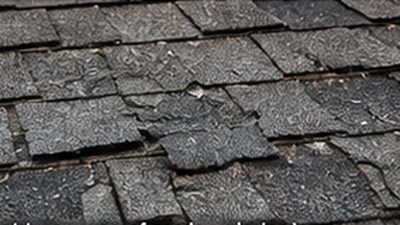
- Curling or cupping edges. Shingle corners lifting or turning up. Often most visible on the sunniest slope.
- Bald patches where the black mat shows through.
- Cracked or split shingles, particularly in a pattern rather than isolated.
- Missing tabs after wind. One is bad luck; several across a slope means the adhesive seal has aged out.
- A wavy or uneven roof plane. This one matters — it usually means the decking underneath has moved, and that is a structural issue rather than a covering issue.
- Moss or heavy algae streaking, typically on north-facing slopes. Holds moisture against the surface.
- Sagging along the ridge or any dip in the roof line. Sight along it from a distance.
- Exposed nail heads or failed sealant around vents and flashings.
What to look for inside
Interior signs are often the first real evidence, and they are the ones people most often misattribute to something else.
- Ceiling stains, especially near exterior walls or below a valley. A dried old stain still tells you water got in at some point.
- Peeling paint at ceiling edges or on the upper part of exterior walls.
- Damp or musty smell in upstairs rooms or closets on an exterior wall.
- New cracks where ceilings meet walls.
The attic tells you the most
This is the part homeowners skip and it is the most informative. Take a flashlight, go up on a bright day, and turn the light off once your eyes adjust.
- Daylight through the sheathing. If you can see it, water can get through it.
- Dark staining or streaking on the underside of the deck. Trace it up-slope to find the entry point.
- Frost on the underside on a cold morning, or water dripping on a warm one. That is condensation rather than a leak — a ventilation problem, and a different fix entirely.
- Soft, spongy or delaminating sheathing. Press it.
- Compressed or missing insulation, particularly pulled back from the eaves.
- Bath fans venting into the attic rather than through the roof. Common, and quietly destructive.
- Blocked soffit vents, stuffed with insulation and no baffles.
- Active water entering during rain or thaw
- A visibly sagging roof plane or ceiling
- Daylight visible through the roof deck
- Widespread soft decking underfoot in the attic
- A section of covering gone after a storm
The winter question specifically
A roof that is merely tired will usually get through another Minnesota winter. What will not is a roof with a compromised water path, because winter is when your roof is tested hardest — snow sitting for months, meltwater running under the covering, ice forming at the eaves and levering things apart.
So the honest triage is: cosmetic wear can wait; a compromised water path cannot. Granule loss and mild curling are cosmetic wear. Failed flashing, lifted shingles at a valley, and an ice barrier that stops short of the code line are a compromised water path.
The trouble is that the second category is largely invisible from the ground, which is the entire argument for having somebody look properly before the snow arrives rather than after.
What an honest assessment looks like
You are entitled to more than a verdict. A proper assessment should produce:
- Photographs of what was actually found, which you keep either way
- Decking condition where it can be established
- Ventilation assessed — intake and exhaust, measured against attic area
- Existing ice barrier coverage measured against the MN Residential Code R905.1.2 line
- A timeframe, not a binary. "Three or four years" is a legitimate answer
And if your roof is fine, the report should say your roof is fine. We would rather be the company you call in four years than the one that sold you something early.
If it is time
Once you are past the decision, the next questions are what to put back on and how to compare bids on substance:
- The honest 15, 30 and 50-year arithmetic — asphalt genuinely wins at some horizons
- The seven lines that decide a metal roof
- What it costs in this market
Free assessments across Monticello and the surrounding communities — call (763) 342-0499.