Free metal roof assessments across Monticello and Wright County

Monday–Friday, 7:00 AM – 6:00 PM (763) 342-0499

Metal Roofing Services · Monticello, MN

Exposed-Fastener & Ag Panel Roofing in Monticello, MN

The cheapest metal roof you can buy, and the one most often installed badly. On a pole barn or shop the panel is rarely what fails — the fasteners are.

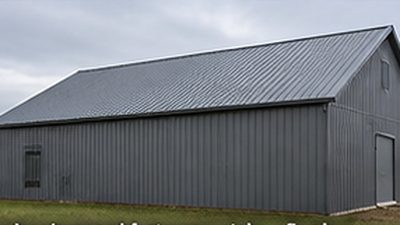
Exposed-fastener agricultural steel panel roof on a pole barn near Monticello, Minnesota
Through-fastened panel on a rural Wright County outbuilding. Every screw is a serviceable part.

The system, and its one weakness

Exposed-fastener panel — often called ag panel, R-panel or through-fastened — is a ribbed steel sheet screwed directly through the face into purlins or decking below. It is fast to install, uses less material than a seamed system, and costs a fraction of standing seam. Around rural Wright County and Sherburne County it is on most shops, barns, machine sheds and detached garages, and correctly so.

Its weakness is structural to the design: every square of roof carries dozens of holes through the weather surface, each sealed by a rubber washer compressed under a screw head. The steel is not the consumable part. The washers are.

The part almost nobody explains before selling you one

A through-fastened roof is a serviceable assembly, not a fit-and-forget one. Budget a re-screw between years 12 and 20 — oversized fasteners into fresh material, new washers. Done on schedule it is cheap. Left until water has been tracking into the purlins for five winters, it is a deck repair.

Standing seam versus exposed-fastener panel in cross-section Standing seam hides its clips and fasteners beneath raised seams, so nothing penetrates the weather surface. Exposed-fastener panel is screwed through the face, sealing on a rubber washer at every screw. Standing seam Concealed clip. Nothing through the weather surface. roof deck seam clip, hidden panel slides 0 penetrations 40–60 years. Inspect only. Floating clips let a 40 ft panel grow and shrink about 0.375″ across a Minnesota year. $12–16 / sq ft installed Exposed fastener Screwed through the face. Every screw is a seal. purlin or deck washer seals here Dozens of penetrations per square 20–30 years. Re-screw at 12–20. The steel outlasts 40 years. The rubber washers under the screw heads do not. $4–8 / sq ft installed
The difference is not the steel — both use the same substrate. It is how many holes go through the weather surface. Standing seam suits a heated, occupied house; exposed-fastener panel is the right engineering choice on a shop, barn or detached garage, provided the re-screw is budgeted from the start rather than discovered at year fifteen.

Where these roofs actually fail

Over-torqued screws

The most common installation fault by a wide margin. A screw gun set too aggressive crushes the washer, squeezing it out past the head. A crushed washer is not a seal, it is a shim — and it will let water past within a couple of seasons. Correctly driven, the washer compresses to slightly beyond the edge of the metal head and no further.

Screws in the rib instead of the flat

Fasteners belong in the flat of the pan, where the washer seats against a surface fully supported by the purlin underneath. Driven through the raised rib, the panel deflects, the washer never seats evenly, and the joint fails early.

Ignoring thermal movement on long runs

The same physics as any metal roof. A long panel grows and shrinks with temperature, and rigid fasteners fight it every cycle. On long runs this needs a deliberate fastening pattern rather than a uniform grid driven by habit.

Condensation, on a building nobody thought would have it

This one surprises owners. An unheated shop with a bare steel roof and no vapour control will drip on a spring morning — warm humid air meeting a cold panel underside. It gets diagnosed as a leak, and it is not. The fix is a condensation control layer or vented assembly, not more sealant.

How we install it

Panels sized to the run, minimizing end laps — every lap is an opportunity for capillary draw. Fasteners in the flat, on a set pattern, driven with the gun clutched to a tested torque rather than by feel. Closure strips at eave and ridge to keep out wind-driven snow, which in an open field west of town is not a theoretical concern.

On heated or insulated buildings we specify a condensation control strategy before the panel goes on, not after the owner reports a leak that is not a leak.

Honest comparison

Exposed-fastener panel compared with standing seam
Exposed-fastenerStanding seam
Installed cost$4 – $8 / sq ft$12 – $16 / sq ft
Penetrations in weather surfaceHundredsNone
Scheduled maintenanceRe-screw at 12–20 yrsInspect only
Realistic service life20 – 30 yrs40 – 60 yrs
Best onShops, barns, outbuildingsHeated, occupied houses

What it costs

Exposed-fastener panel runs roughly $4 to $8 per square foot installed. Simple rectangular roofs with long unbroken runs sit at the bottom of that range, which is why pole barns are the ideal application — few penetrations, no valleys, nothing complicated.

We install these across rural Becker, Big Lake, Clearwater and the surrounding townships. If your outbuilding roof is leaking and the panel still looks sound, start with repair — it is very often a fastener problem rather than a roof problem.

Exposed-Fastener & Ag Panel Roofing — questions we get asked

The steel panel will commonly outlast 40 years. The washers under the screw heads will not — they are typically good for 15 to 20, and less if they were over-tightened at installation.

Plan on a re-screw somewhere between years 12 and 20. Budgeted for, that is a modest maintenance job. Ignored, it is how water gets into the deck and the building.

Thermal movement, mostly. The panel expands and contracts and works against a fastener that is rigidly fixed into the purlin below. Over hundreds of cycles the hole elongates slightly and the screw loses its grip.

It is worse where screws were driven into the rib instead of the flat, where the pilot alignment was off, or where a screw gun was set too hot and crushed the washer on day one.

You can, and some people do — but understand the trade. You are accepting several hundred penetrations through the weather surface on a heated building, in a climate that drives condensation and ice damming.

On a heated, occupied structure we steer people to standing seam. On a shop, barn or detached garage, exposed-fastener panel is a sound and sensible choice.

Usually, and jurisdiction depends on the parcel rather than the mailing address. Properties in Becker Township or Big Lake Township may answer to a different desk than the city of the same name.

We confirm which authority has jurisdiction before filing rather than assuming from the ZIP code.

What actually happens when you call

No sales appointment, no pressure close. Here is the whole sequence, start to finish.

  1. The call

    A person picks up during business hours. We ask the age of the roof, what you are seeing, and whether an insurance claim is already open — that last answer changes the whole process. If your roof does not need work yet, we will tell you on the phone rather than book a visit.

  2. The assessment

    We get on the roof where it is safe to, and into the attic — because on a Minnesota house the attic usually explains the roof. We photograph decking condition, ventilation, existing ice barrier coverage, flashing, and any prior repairs. You get the photos whether or not you hire us.

  3. The written scope

    One page, in plain English: panel profile and gauge, clip and fastener type, ice barrier coverage to code, ventilation changes, snow retention if your roof sheds over a door or walkway, and the price. Line items you can compare against another bid without a decoder ring.

  4. The install and the cleanup

    We pull the permit. We tarp the landscaping, run a magnet over the yard and driveway at the end of every day, and haul the tear-off ourselves. The final inspection is scheduled by us, and you get the closed permit for your records — it matters when you sell the house.

Questions about any step? Call (763) 342-0499 and ask.

Get a straight answer about your roof

We walk the roof, photograph what we find, and tell you whether you need a replacement, a repair, or nothing at all this year. If the answer is nothing, we will say so.

  • Free on-site assessment across Monticello and Wright County
  • Written scope and price before any work begins
  • We pull the permit — you do not
Call now (763) 342-0499

A person answers.
Monday–Friday, 7:00 AM – 6:00 PM
Saturday, 8:00 AM – 2:00 PM

Talk to a roofer

Call and get a straight answer

We walk the roof, photograph what we find, and tell you whether you need a replacement, a repair, or nothing at all this year. If the answer is nothing, we will say so.

(763) 342-0499

A person answers — Monday–Friday, 7:00 AM – 6:00 PM · Saturday, 8:00 AM – 2:00 PM

  • Free on-site assessment Across Monticello and Wright County. You keep the photographs either way.
  • No pressure on the call If your roof has years left, we will tell you on the phone rather than book a visit.
  • We pull the permit Filed with the right authority and the final inspection booked by us.

Outside business hours? Call anyway and leave a message — we return them the next working morning.

Call now Pricing Services