
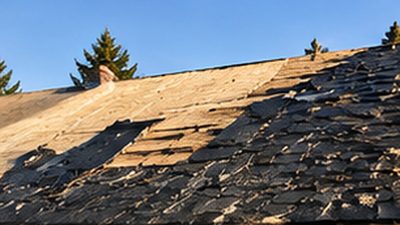
Two ways to do this, and they are not equal
Replacing a roof with metal comes down to one early decision: full tear-off to the deck, or a recover laid over what is already there. Contractors have incentives on both sides — tear-off bills more hours, recover wins more bids on price — so it is worth understanding the call yourself.
Full tear-off
Everything comes off down to the sheathing. We see the deck, replace what is bad, install the ice barrier directly to sound wood, and build up from a known starting point. It costs more and it is the right answer most of the time, because it is the only version where nobody is guessing.
Recover over one layer
Metal goes over the existing roof, typically on furring or a purlin system that creates a flat plane and a ventilation gap. Legitimate where the deck is sound and dry. It saves tear-off cost and disposal, and it keeps several tons of shingle out of the waste stream.
Two existing layers. Soft, spongy or delaminated sheathing. Trapped moisture or active leaks. A surface uneven enough to telegraph through the panel. Or simply that nobody can confirm the deck condition. If any of those apply and someone still quotes you a recover, they are pricing to win the job rather than to fix the roof.
What we actually find under a Monticello roof
The failures here are seasonal and repetitive. In rough order of frequency:
- Deck rot along the eave — the signature of years of ice damming, in the exact band the ice barrier was supposed to protect.
- Deck rot around penetrations — plumbing stacks and bath fans where a boot failed years ago and nobody noticed.
- Condensation staining on the underside — not a leak at all, but warm moist air hitting cold sheathing. A ventilation problem, and a new roof will not fix it.
- An ice barrier that stops short of the 24-inch line, or was never installed.
- Bath fans venting into the attic rather than through the roof. Common, and quietly destructive.
The last three are attic and ventilation problems. If we find them, they get fixed as part of the job — see ice dam prevention and attic ventilation. Installing a fifty-year roof over the condition that shortened the life of the last one is not a service, it is a deferral.
How the job runs
- Assessment. Roof and attic, photographed. Pitch, complexity, penetrations and ventilation measured.
- Written scope. Panel profile and gauge, clip type, ice barrier coverage, underlayment, decking rate per sheet, ventilation work, snow retention, price.
- Permit. Filed with the City of Monticello Building Safety Department, or the relevant city for the surrounding communities.
- Material order. Panels roll-formed to your roof's dimensions after the permit is in hand.
- Install. Landscaping tarped, magnet run over the yard and drive at the end of every day, tear-off hauled by us.
- Final inspection. Booked by us. You get the closed permit.
What it costs
Replacement pricing tracks the system you choose: $12–$16 per square foot for steel standing seam, $9–$14 for steel shingle, $4–$8 for exposed-fastener panel on an outbuilding. A recover runs less than a tear-off where it is genuinely appropriate.
The variables that move the number are roof complexity first, decking condition second, and ventilation work third. Roof size matters least of the four, which surprises most people. The pricing page breaks all of it down, including how to compare two bids on substance rather than on the total at the bottom.