
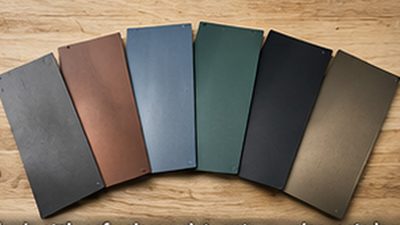
Choosing a metal roof color is the enjoyable part. You get a fan deck, you hold chips against the siding, you argue pleasantly with your partner about whether the greys are actually different.
Meanwhile the specification that governs whether that color survives its first twenty Minnesota winters is usually a line item nobody reads, and there is a real chance nobody has offered you a choice about it at all.
Two paint systems, and they are not close
Factory-applied coatings on residential metal roofing come in two families. The difference is the resin.
SMP — silicone-modified polyester
The budget-to-mid option, and the default on a great deal of residential and agricultural panel. A harder resin, which gives it genuinely better scratch and abrasion resistance than the alternative.
Its weakness is UV. SMP coatings commonly begin to show visible fade and chalking somewhere in the 10 to 20 year range, depending on pigment quality and how much sun that slope takes.
PVDF — sold as Kynar 500 or Hylar 5000
The premium system. A softer, more flexible resin that holds color substantially longer — typically 20 to 30 years or more with markedly slower chalking.
The flexibility matters at manufacture, too. A softer coating is less likely to develop micro fractures when the panel is roll-formed, and those fractures are where degradation starts.
PVDF panel runs roughly 15–35% more than SMP on the material. But labor, underlayment, ice barrier, flashing and disposal do not change at all — and on a residential roof those are most of the job.
So the difference on the total contract is usually modest, against a roof you intend to keep for forty to sixty years. On a house, PVDF is almost always the right call.
Where SMP is genuinely the right answer
We are not arguing that nobody should buy SMP. It is correct for:
- Pole barns, machine sheds and shops where appearance in year twenty is not a consideration and abrasion resistance from equipment contact is.
- Outbuildings on a budget where the whole point is cost per square foot.
- Roofs with very low visibility from the house or the road.
For a through-fastened ag panel roof where the washers will need replacing at year fifteen anyway, matching a 40-year coating to a 20-year serviceable assembly is not obviously good value.
What fade and chalk actually look like
Worth knowing, because homeowners often misdiagnose both.
Fade is loss of color saturation from UV breaking down the pigment. It happens unevenly — the south and west slopes go first, so you often notice it as a mismatch between elevations rather than as a general dulling.
Chalking is the resin binder degrading at the surface and releasing loose pigment as a fine powder. You find it by wiping a finger across the panel and seeing white residue. It makes the roof look hazy and lightened, and it can run down and streak siding below.
Neither is a leak. Neither is a structural problem. Both are purely about whether your house looks cared for, which is not nothing on a fifty-year investment.
Read the warranty properly
Paint warranties are layered, and the headline number is rarely the useful one.
- Film integrity / adhesion — that the coating stays attached. The longest number, often 40 years, and the least likely thing to go wrong.
- Chalk resistance — expressed as a maximum rating on a standard scale.
- Color fade — expressed as a maximum color shift in Hunter or Delta E units.
The fade and chalk terms are the ones that describe how the roof will look. They are also color-dependent: reds, bright blues and some greens carry shorter fade coverage than earth tones and greys, because those pigments are inherently less UV-stable.
So "40-year paint warranty" tells you almost nothing on its own. Ask for the fade and chalk terms for the specific color you are choosing.
Choosing the color itself
With the paint system settled, the aesthetics:
- Charcoal and dark gray — the safest choice in this market. Reads as slate, works with nearly every siding color, and hides the light dusting of dirt that any roof collects.
- Medium greys and bronzes — forgiving, stable pigments, long fade coverage.
- Blacks — striking on a modern house, but show dust, pollen and snow-melt residue more than charcoal does.
- Greens and barn reds — right on a rural property or an outbuilding; check the fade terms specifically, as these pigments are less stable.
- Weathered copper tones — handsome and distinctive, but a strong commitment on a house you may sell.
A color chip held at arm's length in a kitchen tells you very little. Metal reads dramatically differently at a distance, at an angle, in overcast light, and with snow next to it — which is half the year here.
Ask for a full-size sample panel, put it outside, and look at it over a few days in different weather. Any contractor can get you one.
If you are in a covenanted subdivision
Particularly relevant in Albertville and St. Michael, where a high proportion of housing sits under association covenants.
Most covenants restrict roof appearance — requiring a shingle or shake look, or limiting the palette — without specifying material. A stamped steel shingle in an approved color generally satisfies that language where standing seam might not.
Get written board approval before anything is ordered. Panels are formed for your specific roof and are not returnable stock.
The short version
- On a house, specify PVDF. The material premium is small against the total, and it is the difference between a roof that looks right at year twenty-five and one that does not.
- On an outbuilding, SMP is a sound economic choice.
- Ask for the fade and chalk warranty terms for your specific color, not the headline number.
- Get a full-size sample outdoors before committing.
- If you are in an association, get written approval first.
We specify the paint system by name in every written scope, alongside gauge and clip type — the seven lines that decide a metal roof.