
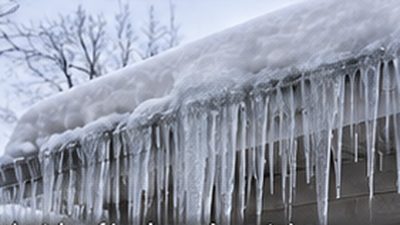
Every metal roofing company in Minnesota has been asked whether their product stops ice dams. A great many of them say yes. It is the single most oversold claim in this trade, and if you buy a roof on the strength of it you will be disappointed in about fourteen months.
Here is the honest version, the physics behind it, and a diagnostic you can run from your own driveway this week.
What an ice dam actually is
Warm air leaks out of your house into the attic. It warms the underside of the roof deck. Snow lying on the warmed part of the roof melts from below — even when the outdoor air is well below freezing. That meltwater runs down the roof surface until it reaches the eave.
The eave overhangs unheated space. It is genuinely cold. The water refreezes there, and it keeps refreezing, building a ridge of ice. Behind that ridge, meltwater pools. Standing water on a roof eventually finds a way under the covering, and then it is on your ceiling.
Read that sequence again and notice what does not appear in it: the roof covering. Asphalt, steel, tile — the mechanism is identical. This is a building envelope failure that happens to express itself at the roof, which is why people keep trying to solve it by replacing the roof.
If your roof is warm enough to melt snow when it is 15°F outside, the problem is that your roof is warm — and no covering you put on top of it will make it cold.
The driveway diagnostic
This costs nothing and takes two minutes. On a cold morning a day or two after snowfall, walk to the end of your driveway and look at your roof.
Snow lying evenly across the whole plane means the attic is cold and doing its job. The roof is the same temperature as the air. That is what you want, and it is what a healthy house looks like.
Bare patches or early melt lines mean heat is arriving at the deck unevenly. Look at where they are. Melt in vertical stripes often traces the rafters. A melted band along the ridge with snow below it usually means warm air is collecting at the peak. A cleared patch over one room is a hint about what is in that ceiling — recessed lights, an attic hatch, a bathroom.
Ice at the eave with clear roof above it is the classic signature. The upper roof is warm enough to melt; the overhang is cold enough to freeze. That is a textbook ice dam in formation.
Now compare with your neighbors. If your roof clears and theirs does not, on the same street in the same weather, the difference is inside your house.
Why replacing the roof does not fix it
A homeowner who has had ice dams for three winters gets a new roof. The contractor installs a proper ice barrier at the eave, which is genuinely worth having. The following winter the dams come back.
What happened is that the ice barrier did its job. The barrier is not there to prevent damming — it is there to stop the pooled water getting through the deck when damming happens anyway. It is the last line of defense, not the defense.
Under Minnesota's residential code the barrier must run from the lowest roof edge to at least 24 inches inside the exterior wall line, and on slopes of 8:12 or steeper, at least 36 inches measured along the slope. That requirement exists precisely because the code assumes ice dams will form on Minnesota houses. It is damage limitation, written into law.
The actual fix, in order of importance
1. Air sealing
More heat moves into an attic by air leakage than by conduction through insulation. This is the single highest-value action, and it is routinely skipped because adding insulation is easier to sell and easier to photograph.
The usual culprits: the attic hatch, recessed light fixtures, plumbing vent penetrations, chimney chases, the top plates of interior walls, wiring holes, and bathroom fans that terminate in the attic rather than through the roof. That last one is common in houses of a certain age around here, and it delivers a continuous supply of warm, wet air directly onto cold sheathing.
2. Insulation — coverage before depth
Current Minnesota energy code calls for roughly R-49 in the ceiling. Plenty of houses built before the mid-1990s have appreciably less, and many have been disturbed since by somebody running cable or stacking boxes.
Coverage matters as much as the number. Insulation compressed at the eaves, or pulled back from the perimeter, creates a warm band exactly where you least want one — at the top of the wall, right above where the ice forms. Baffles hold insulation clear of the soffit vents while keeping the airflow path from eave to ridge open.
3. Ventilation — balanced, not merely present
The attic needs cold outside air moving through it continuously: in at the soffits, out at the ridge. Code frames this as the 1:300 rule, roughly one square foot of net free ventilating area per 300 square feet of attic floor, divided between intake and exhaust.
The failure we find most often is imbalance, and it is usually the result of a well-intentioned upgrade. Somebody adds a long ridge vent and nobody touches the soffits. With insufficient intake, a ridge vent cannot draw enough air from outside — so it draws it from the house instead, through every gap in the ceiling. The "improvement" increases heat loss into the attic and makes the damming worse.
Intake should always meet or exceed exhaust. If a contractor proposes adding exhaust ventilation without measuring your intake, that is the moment to ask a question.
So where does metal actually help?
Once the attic is right, metal is a genuine advantage — just not the one it gets sold on.
- It sheds snow before snow can become water. A smooth cold panel releases its load rather than holding it for days, and snow that has slid off cannot melt and refreeze at your eave.
- There is nothing for ice to grip. An asphalt shingle's granular surface keys ice in place; a coated steel panel does not.
- No exposed fasteners on a standing seam roof, so the hundreds of small penetrations that pooled water would otherwise exploit simply are not there.
- It tolerates the freeze-thaw cycling that makes asphalt brittle over time.
That is a strong set of reasons to choose metal. None of them is "it stops ice dams."
A metal roof that sheds snow properly sheds it somewhere — in slabs, without warning, usually on the first mild afternoon after a cold spell. If a roof plane discharges over a doorway, a walkway, a deck or a driveway, you need snow retention. This is a safety item, not an accessory.
What to do, and when
This winter: rake snow off the lower few feet of roof from the ground between storms. If a dam has already formed and water is coming in, get it steamed off by somebody who does that professionally. Do not go up there with a hammer — you will damage the roof, and roof work on ice is genuinely dangerous.
This summer: get into the attic and deal with the cause. Air sealing first, insulation second, ventilation balance third. If you are already planning a roof replacement, do this work at the same time — the access exists and the roof is open, so it is dramatically cheaper than doing it separately.
And when you are getting quotes, treat "our metal roof will stop your ice dams" as useful information. Not about your roof — about the contractor.
We assess the attic on every quote across Monticello and the surrounding communities. If the honest answer is that your roof is fine and your insulation is not, that is what our report will say.