
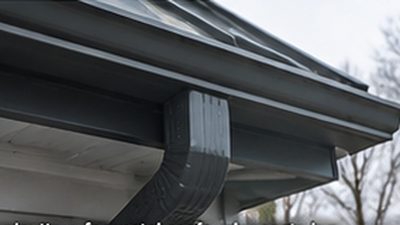
Guttering is the part of a metal roof project that gets decided last, cheapest, and by whoever happens to be doing it. That is a mistake, because two things about a metal roof make standard residential guttering the wrong specification.
Change one: the water arrives faster
An asphalt roof is a rough, granular surface. It slows water down. Runoff arrives at the eave spread out over time.
A metal panel is smooth, and a standing seam roof has continuous channels running ridge to eave that do an efficient job of concentrating flow. Water reaches the gutter faster, in a more concentrated stream, and with more momentum.
The practical consequence in a heavy Minnesota thunderstorm is overshoot — water arriving with enough speed to sail straight over the front lip of a narrow gutter and land on your foundation, which is precisely what the gutter existed to prevent.
The standard residential default is 5-inch K-style gutter with 2×3 downspouts. Under a metal roof, spec 6-inch gutter with 3×4 downspouts.
The wider trough catches fast runoff before it overshoots. The larger downspout moves close to twice the water and clogs far less readily. On a standing seam roof, half-round profiles are also worth considering — better hydraulic efficiency and they self-clean rather than trapping debris in a square internal corner.
On downspout count, a serviceable rule is one for every 30 to 40 feet of gutter run, though the real figure depends on roof area and pitch. A long run with a single downspout at one end is a guaranteed overflow point in a downpour.
Change two: the snow leaves all at once
This is the one that actually destroys guttering, and it is specific to metal in a snow climate.
An asphalt roof holds its snow and melts it off gradually. A metal roof holds a full load and then releases it in slabs, without warning, usually on the first mild afternoon after a cold spell.
That slab travels down the slope and meets the first thing in its path. If your gutter face sits higher than the plane of the roof panels — which on many installations it does — the gutter is that thing.
A gutter cannot resist sliding ice and snow. It is a thin channel hung on brackets, engineered to carry water to a downspout. It is not structural, and it will fold, tear off its hangers, or pull the fascia with it.
The fix is on the roof, not the gutter
You do not solve this by buying stronger gutters. You solve it by not letting the snow arrive as a slab in the first place — which is what snow retention does. Engineered guards hold the load on the field of the roof where it melts and drains gradually.
On a standing seam roof this is particularly clean, because retention clamps onto the seam with setscrews and needs no penetration of the weather surface at all.
And then build the gutter to take some abuse anyway
- Steel rather than aluminum where slide risk is real. Thin aluminum crushes; steel takes a hit that aluminum will not.
- Close-spaced hangers. Standard spacing assumes water weight, not impact. Tighter spacing spreads the load.
- Hidden hangers screwed into solid backing, not spike-and-ferrule into aged fascia.
- Gutter face at or below the roof plane where the design allows, so a slide passes over rather than into it.
Ice, which is the other winter problem
A gutter full of ice is heavy, and it is a dam sitting at the coldest part of your roof. It does not cause ice dams — that is an attic problem — but it absolutely makes an existing one worse by giving the ice somewhere to anchor.
Two things help materially. Keep gutters and downspouts clear going into winter, because a blocked gutter is a container. And make sure downspouts actually discharge — a downspout that freezes solid at the bottom backs the whole system up.
Heat cable in gutters is a symptom treatment, same as heat cable on a roof. There are legitimate uses for it, but it should follow air sealing, insulation and ventilation rather than substitute for them.
Where the water goes after the downspout
Worth stating because it is where most of the actual damage happens, and it costs almost nothing to get right.
A downspout that discharges at the base of the wall is delivering the entire roof's runoff directly to your foundation, repeatedly, for decades. Extensions should carry water a meaningful distance out — four to six feet minimum — onto ground that slopes away.
In winter that discharge point also matters for a different reason: water pooling and freezing on a walkway or driveway next to the house is a slip hazard that appears every thaw.
Do it during the re-roof
If you are replacing the roof, decide the guttering at the same time.
The gutters have to come off for the roof work anyway. The fascia and edge detail are exposed and inspectable. The crew is already there with access equipment. Replacing guttering at that moment is dramatically cheaper than treating it as a separate project, and it means the drip edge, the gutter, and the snow retention are all specified as one system rather than three decisions made by different people at different times.
The short version
- 6-inch gutter, 3×4 downspouts. Standard 5-inch overshoots under a metal roof.
- One downspout per 30–40 feet of run, more on large or steep roofs.
- Snow retention is not optional if the roof discharges over guttering you want to keep.
- Steel and close-spaced hangers where slide risk is real.
- Carry the discharge four to six feet from the foundation.
- Specify it during the re-roof, not two years later.
We spec guttering and snow retention as part of the written scope rather than as an afterthought — what else belongs in one. Call (763) 342-0499.